LLM-PathwayCurator
 Enrichment interpretations → audited, decision-grade pathway claims.
LLM-PathwayCurator is a quality-assurance (QA) layer for enrichment analysis (EA) interpretation.
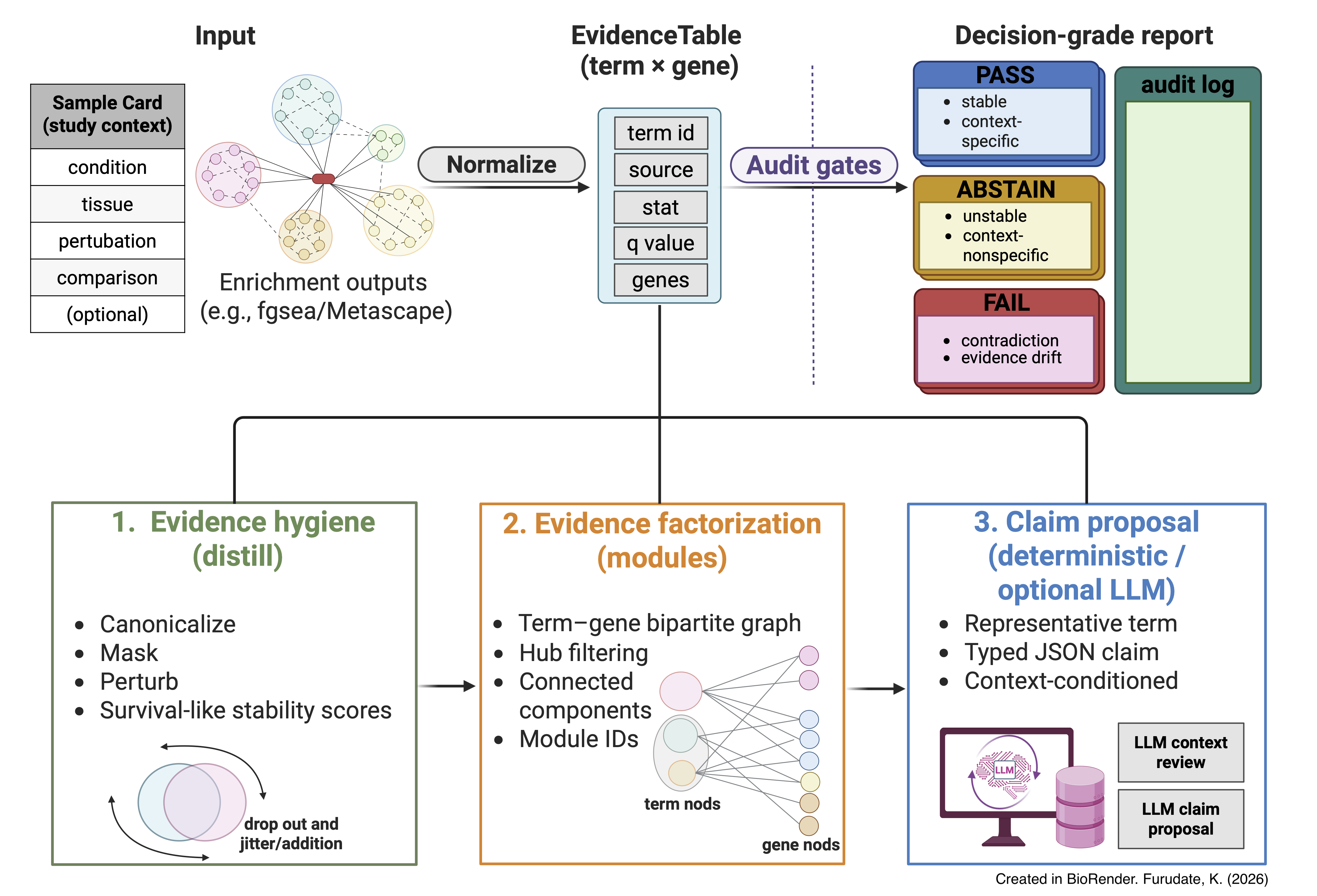
It does not introduce a new enrichment statistic. Instead, it turns EA outputs (ranked term lists) into evidence-linked, typed claims and assigns PASS/ABSTAIN/FAIL via a mechanical audit suite.
Core promise: we abstain when claims are unstable, under-supported, contradictory, or context-nonspecific.
Why this exists (the practical pain)
Enrichment tools return ranked term lists. In practice, interpretation becomes non-reproducible because:
- representative terms are ambiguous under the study context
- gene support is opaque → cherry-picking risk
- related terms share / bridge evidence in non-obvious ways
- there is no mechanical stop condition for fragile narratives
LLM-PathwayCurator converts “plausible narratives” into auditable decision objects.
What you get
- EvidenceTable: term × supporting-genes contract (works for ORA and rank-based EA)
- Evidence distillation: supporting-gene perturbations → stability proxies (survival-like scores)
- Evidence modules: factorization of the term–gene graph (shared vs distinct evidence)
- Typed claims (JSON): schema-bounded, evidence-linked (no free text required)
- Mechanical audits: predefined gates → PASS/ABSTAIN/FAIL + reason codes
- Decision-grade report: audit log + provenance + reproducible outputs
Quick start
pip install llm-pathway-curator

llm-pathway-curator run \
  --sample-card examples/demo/sample_card.json \
  --evidence-table examples/demo/evidence_table.tsv \
  --out out/demo/
Key outputs:
- audit_log.tsv (PASS/ABSTAIN/FAIL + reason codes)
- report.md, report.jsonl (decision objects)
- distilled.tsv, modules.tsv, term_modules.tsv, term_gene_edges.tsv
- run_meta.json (pinned parameters + provenance)
Next
- Start here: Getting started
- Learn the contracts: Concepts
- End-to-end usage: User guide
- Adapters (inputs → EvidenceTable): see Adapters docs
- API docs: API reference
Notes
- LLM is proposal-only (optional): representative selection + typing.
- Acceptance is never delegated: PASS/ABSTAIN/FAIL is decided by mechanical audits.
- Counterfactual stress tests are internal (e.g., context swap, evidence dropout): no external knowledge required.